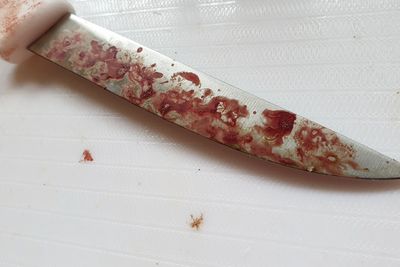
Heirloom
(The first time I met you, you were such an innocent thing. You grasped at me so carefully, as if my touch would tear your skin. I swore that day that I would love you. No matter how time might twist us.)
The murder of Kristi Turner hangs heavy over Foley Park. A devoted mother of two, with a third well on the way, the news of her demise hit the community like a wrecking ball that distant autumn morning.
It was in the early hours of November, in that slow transition between holidays, that the police were first called to the Turner residence. It was not their first time at the address, that much is public knowledge. Over the years there had been several wellness checks made to the young couple, as their fights grew ever more common. Yet, what the officers found inside would turn their stomachs.
Though no press was allowed inside in order to preserve the scene, Commissioner Alvarez was quick to offer this official report:
"Earlier today, Kristi Turner– age 35– was found dead in her home from multiple stab wounds to the chest. Though the investigation is still ongoing, it is currently believed that the majority of the wounds were delivered post-mortem by a single suspect, with the initial killing blow entering her heart directly via a bladed implement. Along with her, the bodies of her two children– three year old Archie, and seven year old Dorothy– were also recovered at the scene. Both are being held at the State University Hospital under heavy guard and are in critical condition. We will not be taking any further questions regarding them at this time."
Regarding potential suspects, Commissioner Alvarez stated the following:
"Currently, there is no news regarding the whereabouts of Kristi's husband, Jack Turner. However, he is considered a person of interest in this case, along with another man spotted in the neighborhood earlier that day. Our department is currently engaged in a manhunt for both men, and as such we are prepared to offer a reward of one thousand dollars for any information that could lead to their locations."
And finally, when asked about any additional leads, he is on record as stating:
"Yes, we are currently investigating several routes of interest. Most notably, it has been brought to my attention by the excellent work of our county coroner, Doctor Herman Peters, that the instrument utilized in this murder was likely a butcher knife, with its blade between seven and nine inches long, of old German make. The pattern of blood spatter, and the measurements of Kristi's wounds seem to point towards a cutting-and-slicing knife rather than a standard cooking tool that one might pick up at the store. This blade is likely a vintage model– perhaps even a family heirloom– and if found should be handed over to the police promptly. Thank you."
Of their three children, only little Dorothy Turner would survive. Though initially believed to have suffered the same degree of wounds to her chest, doctors later noted that her wounds had somehow managed to stop just short of her heart. As the on-site nurse noted to the Sacramento Bee:
"I have seen my fair share of stabbings in my tenure, and each is its own horror. I will, for the sake of civility, not paint the full picture, but it was as if some outside force had intervened in the moment of the trauma. It was not that the assailant had pulled back in the blows, however. Only that it stopped short. I am unsure if this means there was another figure in the room at the time, or if it was an act of god. But whatever the case, the blade tip was millimeters from the poor girl's heart. One inch more, and she would be dead."
Some have taken this medical report as evidence that Kristi was, in fact, alive at the time of the children's' murder and may have attempted to intervene. However, further studies on Kristi's body have shown distinct signs of composition, which contradicts that timeline. As no signs of a third party have yet been found, this has left many to conclude that Dorothy's survival was, indeed, a miracle.
But then, you'd think the real miracle would have been if none of them had died.
For there were signs. Subtle, true, but signs none the less. Jack Turner was a man of habit, everyone knew, and kept a tight schedule in his commutes to and from work each day. He would start with a cup of coffee from home, stop at the grocer for a sandwich, and spend his day at the slaughterhouse until the sun set. Those on his street knew of his returns by how his children would run inside so as to not block the driveway. Yet, on the day of Kristi's murder neither his car nor his children were seen about town. And though the Turners were avid believers in homeschooling, that did not explain why Jack had decided to write to his employer in the days prior, announcing his family's spontaneous decision to go on vacation.
(Over the years I watched you grow, even as my edge grew dull. You were such a sensitive boy. Like your father before you. And though I had no mouth, I shared my love in all the ways I could. In an extra slice of dessert, or an apple in the midst of summer. I marveled at how fast you were growing, but could not fathom what you might do.)
Taken together, Jack's guilt was decided long before his whereabouts became known. And even then, it was often said the wait for closure was as tense a time as the community had ever known. Perhaps it was that wait was all that united them, as they gathered by their television screens– hoping against hope that justice could still be delivered.
Or, if not justice, then perhaps something resembling it.
And to be sure, they did not need to wait long. Less than a week after the initial investigation grew cold, Jack Turner's body was found dead in a neighboring county from a single stab wound to the stomach. According to those who saw the body, the man's intestines had been spilled onto the floor, and his face locked into an image of pain. No force could close the man's eyelids, nor any tool remove the weapon from his grasp. In the end, the police were forced to break Jack Turner's fingers– one after the other– in order to free the knife from his gut.
As many suspected, the blade was a Solinger Butcher Knife. One that family friends had seen many times prior. It was of old German make, and indeed a family heirloom, just as the coroner had suspected. In a private conversation, Commissioner Alvarez would say of the discovery:
"By guilt or by cowardice, Mr. Turner did us a great service that day. He provided us with the murder weapon, as well as the fingerprints necessary to tie him to his wife's tragic murder. While it may not be how I wanted this story to end, I am at least happy knowing we finally got the evidence needed to give his victims some justice."
And yet, the mystery of the Turner murders persists. Perhaps out of some lingering trauma, or a lack of closure. Whatever the reason, everyone seems to have their own theory about Jack Turner. Why he did it, how his daughter managed to survive, and more than anything what caused his death in the following weeks. For though suicide was the verdict agreed upon by the courts, the coroner's report is far from conclusive:
Disembowelment, as a method of suicide, is far from ideal. Or common. Regardless of who delivered the blow, however, the evidence is clear. The cut began below the subject's belly, and pierced his upper intestines just below the stomach. The cut then seems to run a bit jagged, as if the subject was in great pain– or perhaps struggling. From there the opening runs across the lower torso, and up the abdomen, thus allowing the intestines to be released onto his lap. Finally it seems the blade was forced further inside, such that it nearly reached the back of the rib cage.
Throughout all of this the subject was likely conscious and in immeasurable pain. In my own experience I have never heard of a man inflicting this extent of damage to their own body. And yet, no other prints were recovered from the scene. Furthermore, the blade matches the wounds found at the Turner residence. As such, it is still my opinion that this was self-inflicted.
It would be agony beyond anything I can describe, but I suppose anything is possible.
I am no different in my skepticism. This story is the reason why I returned home, after all. It is why I dared to revisit Foley Park's cracked concrete roads, and tour its long abandoned neighborhood gardens. Much of what I remembered remained. Though, time has nonetheless made its mark over all I once knew. Parks which once held picnics have become derelict, and buildings once brimming with history demolished. We are all victims of time's cruel dance, in that way. Yet, I carried on. For the purpose of finding closure I chose to remain, and arranged interviews with whoever I could manage. Some I had hardly seen since childhood, but many not at all.
And to my delight, they all had something to say.
"No way he killed himself! The idea is absurd!"
Keith Weathers is a large man. All knuckles and chin. Like me, he is a Foley Park native, and followed the story intently throughout his teenage years. Unlike me, however, his pursuit is not fueled by empathy or sorrow. Rather, it is anger that drives him.
"Everyone knows that the Old Mill Meat Plant he worked at was a front for the local cartels," Keith explains to me over beers. "And if you look at the murders they were way too clean. Too precise. I think he learned something and was punished for it. Really a shame. I just hope one day we know who is truly behind it all."
To be quite honest, I am hesitant to publish Keith's theories. For, though he is not the only man in town to hold fast to a conspiratorial approach, I personally find the interpretation distasteful. It does nothing to present an alternative suspect, or explain why the murder weapon was a knife from the family's own cupboard. Like all conspiracies, it lacks complexity. Only a gesture towards a vague other, and the need for evil-doers to be a distant thing. As for me, I've always known evil to be far more personal than we like to admit, and emerging far too close to home.
And besides, I'd hardly call forty-two stab wounds to the chest a clean kill. Not by a long shot.
(What you did cannot be forgiven. What you used me for was wrong. I loved those children as much as I had loved you. Perhaps more. They were innocents, Jackson. And your wife was no less deserving of life. I was a gift to you both, once. Did you think I had forgotten that? Do you think I would not care? Though your blood will not wash away what was taken, I can give you what you seek. An end.)
"The bastard was a coward, plain and simple."
Christina is a local reporter, and a friend of my auntie. She and I have maintained a professional relationship since I first became a crime journalist, and this is not my first time interviewing her. Even still, her confidence never ceases to amaze me.
"All the evidence is there, and family annihilations are not as clean or uncommon these days as we want to admit." Christina shares this with me over a video call while offering me a host of statistics that back her claim. "They are more often carried out with firearms, obviously, but when has murder ever made sense? It's tragic, but that doesn't mean we should abandon the facts. And the facts are that Jack got what he wanted. He killed his wife and child, and then himself. The bastard was never held accountable, and we have to remember that so next time we can be better."
As much as I want to believe Christina's account, it never quite seemed to fit. For, though I have no doubt that Jack Turner was a monster, and likely responsible for the initial murders, the coroner's report still lingers in my mind. Medical data, as I have come to learn, never lies. And more than that, something about the way Jack's hand was closed over the knife haunts me. It was though even in his final moments he was desperate to remove it. Desperate to fight it to the bitter end.
Of course, according to my Oma, the answer is quite clear.
"Think of the knife, my dear. The knife! Did Mister Turner ever ask for its feelings on the matter?"
My grandmother is a kind old thing, with all the strength of a cornstalk and the stature to match. I have never once known her to be a violent person. Quite the opposite. But in that moment, as she mourned the loss of a family she never knew, I saw a fire in the back of her eyes. One that carried a bright, even hue. The sort that might temper steel, or heat a kettle of tea.
"That same knife had been a gift from his mother, and her mother before that! It had watched those kids grow. It had prepared meals for them. Cut them slices from their birthday cakes! Can you imagine a more cruel fate for such a thing than to be used to snuff out the life it had been made to cherish? No, 'twas the knife that killed Jack Turner, that night. No matter who gripped it, if anyone. As for his wife and child, I can only pray for their next life."
And that, I suppose, is something we all can agree on.
(I was a stone, once. Long ago. I was blunt and simple, and thought that to exist was enough. To endure, without meaning. But in the fires of the old country, I was hammered into my proper form. With it I had a purpose. A use. One I thought would last forever. How foolish I was. Maybe one day you will understand, Jackson, when we are both stones once more. But for now we remain as we are. A murderer, and their tool. So, auf wiedersehen, my dear boy. Until we meet again.)
Today, the infamous Turner Knife is on display at the Foley Park town hall, as part of a monument to the community's darkest hour. Though denounced as an act of malice by some, the art installation has for better or for worse become a staple of the community's identity. New couples often visit the monument, and offer flowers to Kristi and Archie's souls. True crime podcasts often make pilgrimages to the site, so they can look upon the infamous weapon in all its grandeur.
Now that I stare at it now, there is little that I can say that can convey all of the horror of the item when seen firsthand. Like all murder, it is a remarkably mundane thing. As common a tool as any I've seen, with its edges dulled into a smooth curve. And when the light catches it just right, you can see where its steel bears the slightest discoloration, from its final bloody act.